

Chronic low back pain
Key Pain Conditions

LBP represents a significant economic and social problem. From 2006 to 2016, the prevalence of both acute and chronic LBP has more than doubled.3 It is estimated that 11.9% of the global population suffers from LBP (either acute or chronic) at any point in time, rising to almost a quarter (23.2%) over any 1-month period.6 The prevalence of cLBP has been reported as 4.2% in people aged 24–39 years and 19.6% in those aged 20–59 years in two separate studies.7 Its prevalence continues to increase as the population ages, and both men and women in all ethnic groups are affected to a similar extent.3
cLBP prevalence rate according to age (six studies)⁷

There are a multitude of potential initiating factors described for LBP. However, many are difficult to interpret because of the high prevalence of back pain in the general population.1,2 Physical factors contributing to LBP include physical status, heavy lifting and, rarely, underlying conditions such as infections, tumours or kidney stones.1 Strong psychological factors also play a role in the development of back pain.2
Risk factors for developing LBP¹
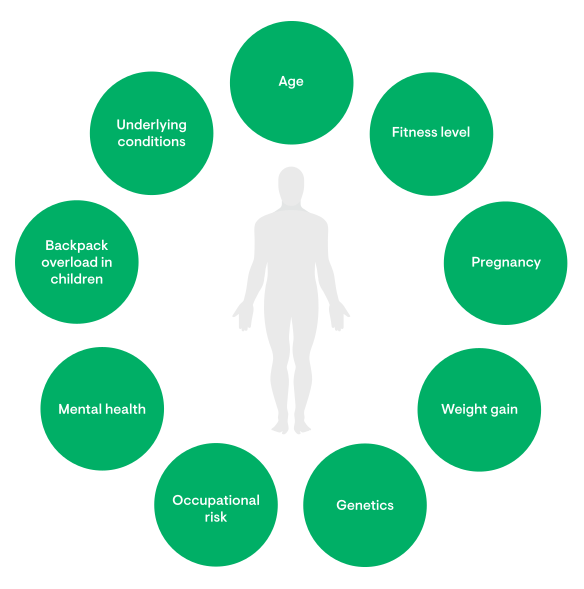
LBP: low back pain.
LBP represents a functional disorder that, in many cases, involves general degeneration of the spine associated with normal wear and damage as people age.1 Often, the exact aetiology of back pain remains unclear, leading to the majority of cases being labelled as ‘non-specific’.1,2 In cases where causes of back pain can be determined, they are mostly mechanical in nature, although these can also be a result of underlying conditions.1
Causes of specific LBP1
| Mechanical causes |
|---|
| Sprains and strains |
| Intervertebral disc degeneration |
| Herniated or ruptured discs |
| Radiculopathy |
| Sciatica |
| Spondylolisthesis |
| Traumatic injury |
| Spinal stenosis |
| Skeletal irregularities |
| Serious underlying conditions |
|---|
| Infections |
| Tumours |
| Cauda equina syndrome |
| Abdominal aortic aneurysms |
| Kidney stones |
| Other underlying conditions |
| Inflammatory diseases of the joints |
|---|
| Osteoporosis |
| Endometriosis |
| Fibromyalgia |
LBP: low back pain.
Pain
Numbness
Tingling sensations

Spasms

Muscle weakness
cLBP: chronic low back pain.
While cLBP often arises from a mechanical cause, neuropathic mechanisms play a part in most cases.1,5 Therefore, cLBP can be classified as a mixed pain syndrome.5
- Tissue injury with a subsequent inflammatory response usually leads to non-specific nociceptive pain.
- Neuropathic pain describes somatic referred pain originating from the lumbar spine and/or nerve roots (radicular pain/radiculopathy).
Studies have demonstrated that a large proportion of patients (20–55%) with cLBP have a higher than 90% likelihood of a neuropathic pain component, which is also suspected in a further 28% of patients.5 Such presence of a neuropathic pain component is associated with more severe pain symptoms and higher healthcare costs.5
Qualities and descriptors of neuropathic vs nociceptive pain5
| Neuropathic | Nociceptive | |
|---|---|---|
| Main characteristics | Maladaptive and chronic in nature | Short-lived response, adaptive, with resolution upon healing of injury. Some inflammatory hyperalgesia may also be present, as is the case with neuropathic pain |
| Qualitative description of pain | Paroxysmal (e.g. electrical shock-like pain, stabbing or shooting); abnormal Thermal sensations (e.g. extreme cold or burning.) Its occurrence may be spontaneous, such as moderate heat or cold (allodynia), light touch or an exaggerated response to painful stimuli (hyperalgesia) | Dull or aching throbbing |
| Cause | Pain that is a consequence of a lesion or disease affecting the somatosensory system, e.g. mechanical neve root compression, local nerve fibre damage, inflammatory mediators arising from a degenerated disc on nerve fibres | Tissue damage, tissue-damaging stimuli, inflammation |

X-rays

Ultrasound imaging

Bone scans
Blood tests

Electrodiagnostics

Magnetic resonance imaging
Discography

Computed tomography

Myelograms
LBP: low back pain.
Guidelines and recommendations
A range of strategies can be used to manage cLBP. These include non-pharmacological and pharmacological as well as surgical treatments.1,2,9 Current treatment guidelines and recommendations include non-pharmacological management, such as hot or cold packs, physical activity to strengthen muscles and medications.1 Acute pain is often temporarily relieved by drugs, though this may not be sufficient to achieve sustained pain relief in the case of cLBP.2 Commonly used medications include non-opioid analgesics, such as paracetamol/acetaminophen and non-steroidal anti-inflammatory drugs, or opioids.2
The latest European Pain Federation position papers are available here: https://europeanpainfederation.eu/advocacy/position-papers
Treatment options for cLBP1,2,9
 Conventional treatments |  Medicines |  Non-surgical procedures |  Surgical procedures |
Hot or cold packs | Analgesic medications | Spinal manipulation and spinal mobilisastion | Vertebroplasty and kyphoplasty |
Activity | NSAIDs | Acupuncture | Spinal laminectomy |
Strengthening exercises | Opioids | Biofeedback | Discectomy or microdiscectomy |
Physical therapy | Anticonvulsants | Nerve block therapies | Foraminotomy |
Traction | Antidepressants | Epidural steroid injections | Intradiscal electrothermal therapy |
| Counterirritants | Transcutaneous electrical nerve stimulaton | Nucleoplasty (plasma disc decompression) |
|
|
| Radiofrequency denervation |
|
|
| Spinal fusion |
|
|
| Artificial disc replacement |
cLBP: chronic low back pain; NSAID, non-steroidal anti-inflammatory drug.
Pharmacological treatments
To guide the choice of treatment, clinicians should investigate the mechanisms underlying the pain.9 As the cause of cLBP can be diverse and multifactorial, and due to the specific mechanisms of action of each drug, determining the pain mechanism may allow for targeted treatment.10,11 However, identifying the pain mechanism based on patient phenotype remains a considerable clinical challenge.10
If the pain is not managed appropriately by a single speciality (e.g. a general practitioner [GP] or orthopaedist), a multimodal approach might be needed.11 Such an approach can combine a variety of modalities with complementary mechanisms of actions (e.g. two pharmacological medications with one non-pharmacological approach). Before initiating a multimodal management plan, drug–drug interactions between modalities should be considered. Depending on the patient’s presentation, different specialities may be involved in the management plan; for example, in degenerative disc disease, the interdisciplinary team might include a GP, orthopaedist, neurosurgeon, physical therapist, pain specialist and others. The importance of utilising an interdisciplinary approach has been demonstrated in cLBP; in Denmark, the rate of lumbar disc surgeries was significantly reduced following the implementation of multidisciplinary non-surgical spine clinics, which involved rheumatologists, physical therapists, GPs, chiropractors, nurses, social workers and occupational therapists.12
Pharmacological treatment options and their effectiveness across different cLBP types¹¹

For more detailed information, see original source Müller-Schwefe G et al. Curr Med Res Opin. 2017; 33 (7):1199-210.
A major unmet need for patients with cLBP is attaining knowledge of the source of pain; patients have a need to know the reason behind their pain and physicians require a clear diagnosis in order to effectively guide treatment. Recent guidelines state that clinicians who see patients with cLBP should explore the mechanisms that underlie the acute/chronic pain.9 This would allow for the use of more tailored therapy to optimise outcomes for the patient and avoid the generalised diagnosis of LBP that may lead to poor treatment. However, the large number of possible physical and non-physical causes of cLBP makes this difficult. In some instances of cLBP, multiple pain generators can work together; in such cases, multidisciplinary diagnosis and multimodal treatment options can be of use.5,13
Epidemiology
LBP represents a significant economic and social problem. From 2006 to 2016, the prevalence of both acute and chronic LBP has more than doubled.3 It is estimated that 11.9% of the global population suffers from LBP (either acute or chronic) at any point in time, rising to almost a quarter (23.2%) over any 1-month period.6 The prevalence of cLBP has been reported as 4.2% in people aged 24–39 years and 19.6% in those aged 20–59 years in two separate studies.7 Its prevalence continues to increase as the population ages, and both men and women in all ethnic groups are affected to a similar extent.3
cLBP prevalence rate according to age (six studies)⁷
There are a multitude of potential initiating factors described for LBP. However, many are difficult to interpret because of the high prevalence of back pain in the general population.1,2 Physical factors contributing to LBP include physical status, heavy lifting and, rarely, underlying conditions such as infections, tumours or kidney stones.1 Strong psychological factors also play a role in the development of back pain.2
Risk factors for developing LBP¹
LBP: low back pain.
LBP represents a functional disorder that, in many cases, involves general degeneration of the spine associated with normal wear and damage as people age.1 Often, the exact aetiology of back pain remains unclear, leading to the majority of cases being labelled as ‘non-specific’.1,2 In cases where causes of back pain can be determined, they are mostly mechanical in nature, although these can also be a result of underlying conditions.1
Causes of specific LBP1
| Mechanical causes |
|---|
| Sprains and strains |
| Intervertebral disc degeneration |
| Herniated or ruptured discs |
| Radiculopathy |
| Sciatica |
| Spondylolisthesis |
| Traumatic injury |
| Spinal stenosis |
| Skeletal irregularities |
| Serious underlying conditions |
|---|
| Infections |
| Tumours |
| Cauda equina syndrome |
| Abdominal aortic aneurysms |
| Kidney stones |
| Other underlying conditions |
| Inflammatory diseases of the joints |
|---|
| Osteoporosis |
| Endometriosis |
| Fibromyalgia |
LBP: low back pain.
Pain
Numbness
Tingling sensations
Spasms
Muscle weakness
cLBP: chronic low back pain.
While cLBP often arises from a mechanical cause, neuropathic mechanisms play a part in most cases.1,5 Therefore, cLBP can be classified as a mixed pain syndrome.5
- Tissue injury with a subsequent inflammatory response usually leads to non-specific nociceptive pain.
- Neuropathic pain describes somatic referred pain originating from the lumbar spine and/or nerve roots (radicular pain/radiculopathy).
Studies have demonstrated that a large proportion of patients (20–55%) with cLBP have a higher than 90% likelihood of a neuropathic pain component, which is also suspected in a further 28% of patients.5 Such presence of a neuropathic pain component is associated with more severe pain symptoms and higher healthcare costs.5
Qualities and descriptors of neuropathic vs nociceptive pain5
| Neuropathic | Nociceptive | |
|---|---|---|
| Main characteristics | Maladaptive and chronic in nature | Short-lived response, adaptive, with resolution upon healing of injury. Some inflammatory hyperalgesia may also be present, as is the case with neuropathic pain |
| Qualitative description of pain | Paroxysmal (e.g. electrical shock-like pain, stabbing or shooting); abnormal Thermal sensations (e.g. extreme cold or burning.) Its occurrence may be spontaneous, such as moderate heat or cold (allodynia), light touch or an exaggerated response to painful stimuli (hyperalgesia) | Dull or aching throbbing |
| Cause | Pain that is a consequence of a lesion or disease affecting the somatosensory system, e.g. mechanical neve root compression, local nerve fibre damage, inflammatory mediators arising from a degenerated disc on nerve fibres | Tissue damage, tissue-damaging stimuli, inflammation |
X-rays
Ultrasound imaging
Bone scans
Blood tests
Electrodiagnostics
Magnetic resonance imaging
Discography
Computed tomography
Myelograms
LBP: low back pain.
Guidelines and recommendations
A range of strategies can be used to manage cLBP. These include non-pharmacological and pharmacological as well as surgical treatments.1,2,9 Current treatment guidelines and recommendations include non-pharmacological management, such as hot or cold packs, physical activity to strengthen muscles and medications.1 Acute pain is often temporarily relieved by drugs, though this may not be sufficient to achieve sustained pain relief in the case of cLBP.2 Commonly used medications include non-opioid analgesics, such as paracetamol/acetaminophen and non-steroidal anti-inflammatory drugs, or opioids.2
The latest European Pain Federation position papers are available here: https://europeanpainfederation.eu/advocacy/position-papers
Treatment options for cLBP1,2,9
Conventional treatments | Medicines | Non-surgical procedures | Surgical procedures |
Hot or cold packs | Analgesic medications | Spinal manipulation and spinal mobilisastion | Vertebroplasty and kyphoplasty |
Activity | NSAIDs | Acupuncture | Spinal laminectomy |
Strengthening exercises | Opioids | Biofeedback | Discectomy or microdiscectomy |
Physical therapy | Anticonvulsants | Nerve block therapies | Foraminotomy |
Traction | Antidepressants | Epidural steroid injections | Intradiscal electrothermal therapy |
| Counterirritants | Transcutaneous electrical nerve stimulaton | Nucleoplasty (plasma disc decompression) |
|
|
| Radiofrequency denervation |
|
|
| Spinal fusion |
|
|
| Artificial disc replacement |
cLBP: chronic low back pain; NSAID, non-steroidal anti-inflammatory drug.
Pharmacological treatments
To guide the choice of treatment, clinicians should investigate the mechanisms underlying the pain.9 As the cause of cLBP can be diverse and multifactorial, and due to the specific mechanisms of action of each drug, determining the pain mechanism may allow for targeted treatment.10,11 However, identifying the pain mechanism based on patient phenotype remains a considerable clinical challenge.10
If the pain is not managed appropriately by a single speciality (e.g. a general practitioner [GP] or orthopaedist), a multimodal approach might be needed.11 Such an approach can combine a variety of modalities with complementary mechanisms of actions (e.g. two pharmacological medications with one non-pharmacological approach). Before initiating a multimodal management plan, drug–drug interactions between modalities should be considered. Depending on the patient’s presentation, different specialities may be involved in the management plan; for example, in degenerative disc disease, the interdisciplinary team might include a GP, orthopaedist, neurosurgeon, physical therapist, pain specialist and others. The importance of utilising an interdisciplinary approach has been demonstrated in cLBP; in Denmark, the rate of lumbar disc surgeries was significantly reduced following the implementation of multidisciplinary non-surgical spine clinics, which involved rheumatologists, physical therapists, GPs, chiropractors, nurses, social workers and occupational therapists.12
Pharmacological treatment options and their effectiveness across different cLBP types¹¹
For more detailed information, see original source Müller-Schwefe G et al. Curr Med Res Opin. 2017; 33 (7):1199-210.
A major unmet need for patients with cLBP is attaining knowledge of the source of pain; patients have a need to know the reason behind their pain and physicians require a clear diagnosis in order to effectively guide treatment. Recent guidelines state that clinicians who see patients with cLBP should explore the mechanisms that underlie the acute/chronic pain.9 This would allow for the use of more tailored therapy to optimise outcomes for the patient and avoid the generalised diagnosis of LBP that may lead to poor treatment. However, the large number of possible physical and non-physical causes of cLBP makes this difficult. In some instances of cLBP, multiple pain generators can work together; in such cases, multidisciplinary diagnosis and multimodal treatment options can be of use.5,13