
Grunenthal Logo

External Link

You are now leaving the Grünenthal website. You will be re-directed to an external website. Grünenthal accepts no responsibility for the content of other websites.

Close up of a senior man in glasses thinking

Definition of pain

Pain Basics

Pain is an unpleasant sensory and emotional experience.1

Key points

  • Pain describes physical suffering or discomfort associated with actual or potential tissue damage.1
  • The 11th revision of the International Classification of Diseases (ICD-11) has recognised chronic pain as a disease in its own right.2,3
  • The biopsychosocial pain model illustrates the various sensorial, cognitive/affective and interpersonal factors that impact chronic pain.4

The International Association for the Study of Pain (IASP) defines pain as “an unpleasant sensory and emotional experience associated with actual or potential tissue damage, or described in terms of such damage”.3 Acute pain is often related to acute injury and trauma and resolves within 3 months; it serves as the body’s warning system.5 Pain that persists or recurs beyond 3 months is considered chronic6 and can occur when pain associated with an injury or trauma persists even after the injury has been physically healed or without any apparent stimulus.5 In contrast to acute pain, chronic pain usually fulfils no adaptive purpose.7 Where chronic pain represents a disease in itself, e.g. if the mechanisms of pain are non-specific and there is significant emotional distress or functional disability, it is classified as chronic primary pain.7 Patients may also experience chronic secondary pain, which arises due to an underlying disease (e.g. arthritis).3,7

For further information on types of chronic pain, please read this review article.

Chronic pain is influenced by a number of processes that, in turn, strongly affect pain.4 The biopsychosocial pain model (Figure 1) provides a framework to understand the multifaceted nature of chronic pain, with biological, psychological and social factors at play and leading to reduced health-related quality of life.4
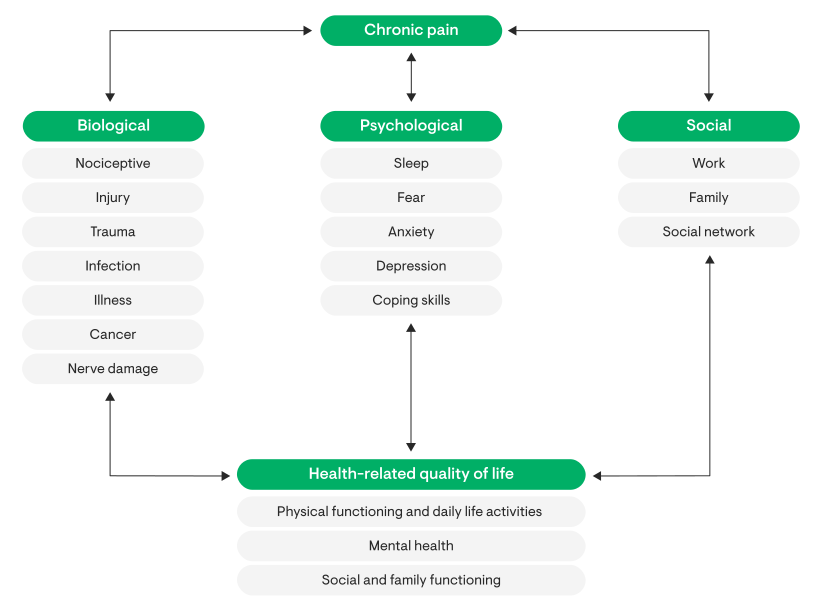
Figure 1: Biopsychosocial model of chronic pain and consequences on the quality of life
Biopsychosocial model of chronic pain and consequences on the quality of life
[Adapted from Dueñas et al. 2016.4]
References
  1. Raja SN, et al. Pain. 2020;161:1976–82.
  2. World Health Organization. ICD-11 for mortality and morbidity statistics (version: 01/2023). MG30.0 Chronic primary pain. Available at: https://icd.who.int/browse11/l-m/en#/http%3a%2f%2fid.who.int%2ficd%2fentity%2f1326332835. Accessed September 2025.
  3. Treede RD, et al. Pain. 2019;160:19–27.
  4. Dueñas M et al. J Pain Res. 2016;9:457–67.
  5. Orr PM, et al. Crit Care Nurs Clin North Am. 2017;29:407–18.
  6. World Health Organization. ICD-11 for mortality and morbidity statistics (version: 01/2023). MG30 Chronic pain. Available at: https://icd.who.int/browse11/l-m/en#/http://id.who.int/icd/entity/1581976053. Accessed September 2025.
  7. Clauw DJ, et al. Postgrad Med. 2019;131:185–98.
M-N/A-HQ-12-19-0008
Definition of pain | Grünenthal